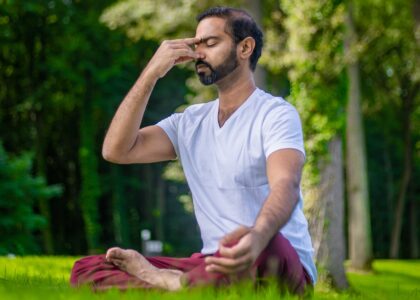
Most breathwork techniques focus on measurable physical effects: heart rate, CO2 levels, nervous system regulation. Somatic breathwork is different. It combines breath with body awareness, movement, and sometimes sound or touch.
I haven’t tried somatic breathwork myself. But I’m curious about it. So I’ve read up on it to gain some knowledge and see if it’s for me. It’s a different category than the techniques in Ma, and worth understanding.
A session might involve sustained circular breathing, attention to where you feel tension, spontaneous movement, sound, or simply staying with whatever arises in the body. The facilitator plays an active role, guiding you through what comes up rather than just pacing your breath. So this is not something you need an app for, you kind of need to go and see an instructor. At least if you’re new to this.
The two categories are not opposites. Many people use technical breathwork as a daily practice and somatic breathwork occasionally for deeper work. Like releasing trauma and so on.
Different Types of Somatic Breathwork
- Holotropic breathwork: Sessions typically last 2-3 hours. Participants lie on mats and breathe rapidly and deeply while music plays. A trained facilitator guides the process. This practice is often done in group settings, with participants taking turns as breather and sitter. The goal is to reach non-ordinary states of consciousness that allow access to psychological and somatic material. This is a really intense practice, not suitable for beginners. Developed by Stanislav Grof.
- Rebirthing breathwork: Uses circular connected breathing, inhaling and exhaling without pausing, to release early emotional patterns including, in Orr’s framework, birth trauma. Gentler than holotropic in structure but can still produce strong responses. Developed by Leonard Orr.
- Biodynamic breathwork: Combines conscious connected breathing with bodywork, movement, and trauma release exercises. Draws on somatic experiencing principles to keep the nervous system regulated during the process. Developed by Giten Tonkov.
- Transformational breathwork: Focuses on a specific breathing pattern designed to increase oxygenation and release physical and emotional tension. Developed by Judith Kravitz.
Is It Safe?
For most people, gentle somatic breathwork practices are safe. Intense approaches like holotropic breathwork can produce strong physical and emotional responses, including crying, shaking, and altered states of consciousness. These are generally considered part of the process, but they require a trained facilitator and a safe environment.
People with a history of psychosis, severe trauma, cardiovascular conditions, epilepsy or people who are pregnant, should consult a doctor or mental health professional before trying somatic breathwork.
Note: It is not a replacement for therapy.
Where It Comes From
The roots go back to Wilhelm Reich, a psychoanalyst working in the 1930s who believed that repressed emotions manifest in the body as chronic muscular tension, what he called body armor. His ideas influenced Alexander Lowen, who developed bioenergetics in the 1950s, and later Peter Levine, who developed somatic experiencing in the 1970s. The latter after observing that animals in the wild discharge stress through shaking and movement (have you seen this? It’s really cool to watch), and that humans, with more complex nervous systems, often interrupt this process and get stuck.
Stanislav Grof developed holotropic breathwork in the 1970s after LSD was banned in the United States. Having used LSD therapeutically to help patients access deep psychological material, he looked for other ways to reach similar states. He found that intense, sustained breathing combined with evocative music could produce comparable experiences. Leonard Orr developed rebirthing breathwork around the same time, using circular connected breathing to access and release early emotional imprints.
How It Relates to Ma
The techniques in Ma, box breathing, coherent breathing, Wim Hof, bhramari, 4-7-8, and nadi shodhana, are self-guided practices for daily regulation. you follow a specific pattern, and the body responds in predictable, measurable ways. The goal is regulation, focus, or physiological performance. They work through measurable physiological pathways and are well suited to independent practice.
Somatic breathwork sits in a different category. It is more therapeutic in nature, often requires a facilitator, and is better suited to occasional deeper work than daily practice. If you are dealing with chronic stress, anxiety, or trauma, somatic breathwork may be worth exploring alongside, not instead of, a regular breathwork practice.