

Alternate nostril breathing balances the nervous system by breathing through one nostril at a time. Calming, focusing, and surprisingly effective for mental clarity.
I found nadi shodhana a little tricky at first. When doing breathwork you kind of don’t want to be to focused on the technique itself, and more so on the breathing, and since I am somewhat lacking in the coordination department I had a bit of a hard time getting the hand movement to sync with the breath. It took me a few sessions and some practice to get to a relaxed point. But it’s worth sticking with!
Alternate nostril breathing is a pranayama technique where you breathe through one nostril at a time, alternating sides with each breath. It balances the nervous system, lowers heart rate and blood pressure and improves focus and cognitive function.
How To
Note: This technique requires clear nasal passages.
Sit comfortably with your spine upright.
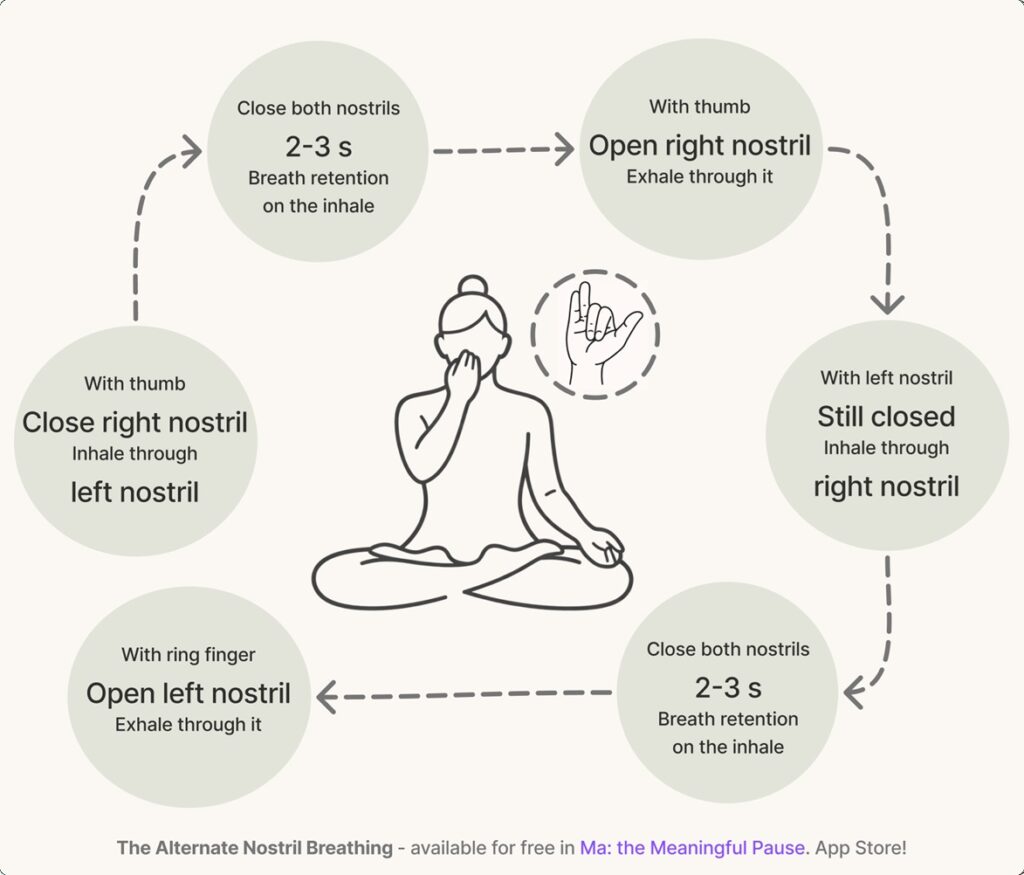
- Vishnu mudra position: Bring your right hand to your nose. Fold your index and middle fingers into your palm, leaving your thumb, ring finger, and little finger extended. This is Vishnu mudra.
- Breathe in through left nostril: Use your thumb to close your right nostril. Inhale slowly through your left nostril.
- Breath retention: At the top of the inhale, close both nostrils and hold briefly, 2-3 seconds to start.
- Breathe out through right nostril: Release your thumb – not the ring finger – and exhale slowly through your right nostril.
- Breathe in through right nostril: Continue keeping your left nostril closed with your ring finger. Inhale through your right nostril.
- Second breath retention: At the top of the inhale, close both nostrils and hold briefly, 2-3 seconds to start.
- Breathe out through left nostril: Release your ring finger and exhale through your left nostril.
- Repeat: That is one cycle. Always begin with the next round with an inhale through your left nostril.
Repeat for at least 5-0 minutes.
Make it beginner-friendly: the classical version of nadi shodhana includes a brief breath retention after each inhale. But there is also a simpler version, known as anulom vilom, which is the standard starting point for most practitioners. In that version you just skip the breath retention and go straight to alternated nostril breathing.
Use my free app Ma to get guided audio cues, ambient sound in the background and timer functionality.
What to Expect
The first few sessions feel mechanical. You are tracking the hand, the nostril, and the breath simultaneously and that takes concentration. Most people find it becomes automatic after three or four sessions. Once the pattern is familiar, the technique produces a distinctive quality of calm: alert but settled, focused but not tense.
Safety
People with asthma or COPD should be careful. Skip the breath retention if you are pregnant or have high blood pressure.
What Happens in the Body
Each nostril is connected to the opposite hemisphere of the brain. The left nostril activates the right hemisphere and the parasympathetic nervous system, producing a calming effect. The right nostril activates the left hemisphere and the sympathetic nervous system, producing a more alert state. Alternating between them balances the two.
This is not only yogic theory. EEG studies have shown that alternate nostril breathing produces measurable changes in brain hemisphere activity, moving both toward balance. Its primary effect is balance rather than activation or deactivation. It neither strongly calms nor strongly energizes, but it regulates.
Where It Comes From
Nadi shodhana means channel purification in Sanskrit. Nadi means energy channel, shodhana means purification or cleansing. The practice appears in the Hatha Yoga Pradipika, the 15th century text that systematized many of the pranayama techniques still used today.
In yogic anatomy, Ida and Pingala are the two primary energy channels that run along the spine and meet at the nostrils. Nadi shodhana is designed to balance these channels. Modern physiology maps onto this: the left and right nasal passages connect to different branches of the autonomic nervous system through the contralateral brain hemispheres.
Note: nadi shodhana and anulom vilom are often used interchangeably, but technically nadi shodhana includes a brief breath retention after each inhale. Most modern practice taught in yoga classes omits the retention and uses the terms synonymously.
What the Research Shows
A systematic review of 44 randomized controlled trials found strong evidence for positive effects on the autonomic nervous system and cardiovascular function, including reduced heart rate and blood pressure.
A 2017 randomized controlled pilot study found that alternate nostril breathing significantly reduced anxiety in healthy volunteers exposed to a simulated public speaking task.
Research also suggests improvements in working memory and cognitive function, though most studies in this area are small.
Building a Practice
Five minutes daily is enough to notice a difference. Morning practice before meditation works well, as the balancing effect prepares the mind for sitting. You can also use it during the day when you feel mentally scattered or before tasks that require sustained focus.