
Want to go from stressed to calm in minutes? Try bhramari. The humming bee breath is one of the fastest pranayama techniques for shifting your nervous system. Here’s how it works.
Bhramari is a humming breath technique from the pranayama tradition. The exhale is released as a continuous hum, creating vibration in the skull and sinuses that stimulates the vagus nerve and produces a rapid parasympathetic response.
What I notice most about bhramari is the vibration. You feel it in your chest, your throat, sometimes all the way down into your belly. In that way, it’s unlike any other breathwork method.
How To
Sit comfortably with your spine upright.
- Breathe in. Inhale through your nose.
- Breathe out with a humming sound. On the exhale, hum with your mouth closed. The sound should resonate in your face and head. Keep humming until your breath runs out.
- Repeat. Each inhale and humming exhale marks one cycle.
If needed, you can place your fingers lightly over your ears to deepen the internal resonance. Repeat for at least 5-10 cycles.
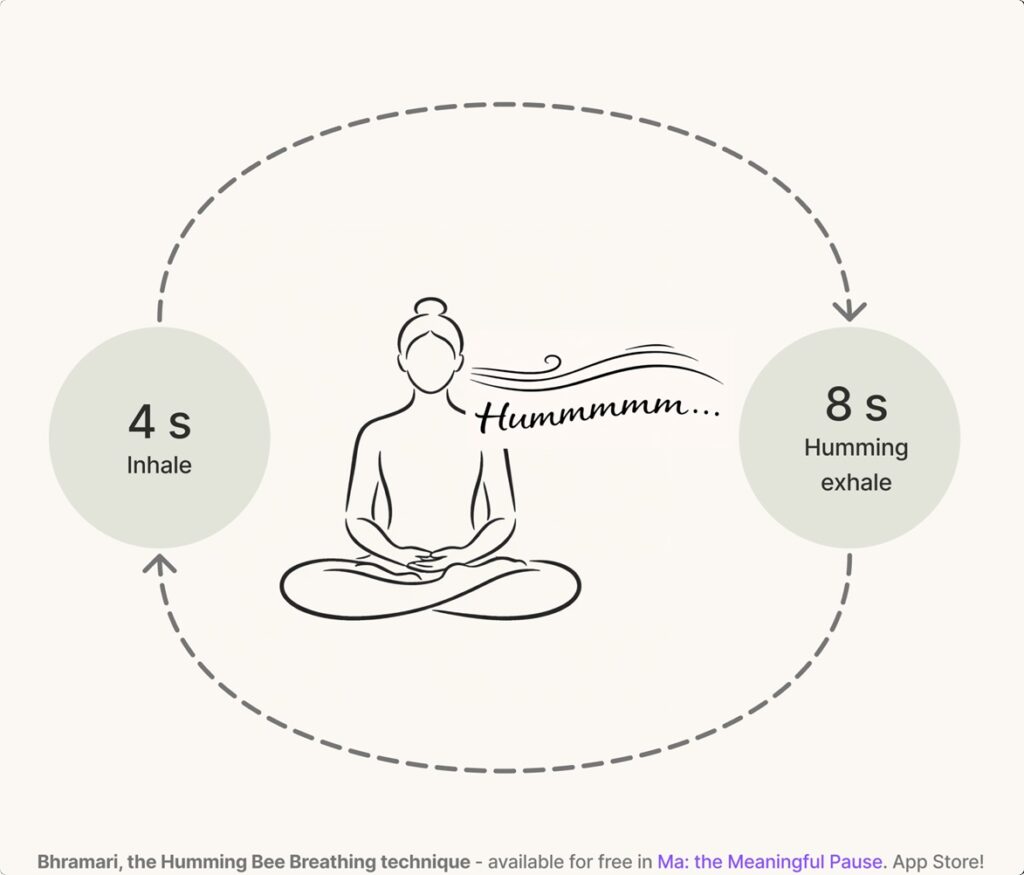
If you want to practice without timing yourself, Ma hums with you through each cycle!
What to Expect
The effect is fast. Most people notice a shift within two or three cycles. The vibration gives the mind something concrete to follow, which makes it easier to stay present than with silent techniques. Some people find it slightly awkward at first, especially in a shared space. Thankfully, that passes. Even I, who is a bit shy, can now do this among other breathwork participants.
What Happens in the Body
The continuous hum on the exhale creates physical vibration in the skull, sinuses, and chest. That vibration stimulates the vagus nerve through acoustic resonance, which triggers a parasympathetic response. Heart rate drops, blood pressure lowers, and the nervous system shifts toward rest.
A study measuring HRV under three conditions, rest, slow-paced breathing, and bhramari, found that both breathing conditions significantly increased HRV compared to rest, with no significant difference between the two. Bhramari produces autonomic effects comparable to coherent breathing, but without requiring counted timing or specific ratios. The hum does the regulating.
The extended exhale also plays a role. Longer exhales activate the parasympathetic nervous system independently of the humming, so bhramari works through two mechanisms at once.
Safety
Bhramari is gentle and safe for most people. If you feel light-headed, you are breathing too forcefully. Soften the hum and reduce the depth of each inhale. It is however, not recommended during pregnancy, at least without guidance.
Where It Comes From
Bhramari comes from the pranayama tradition, and is named after the Indian black bee. The name refers to the humming sound of the exhale. It appears in the Hatha Yoga Pradipika, the 15th century text that systematized many of the pranayama techniques still practiced today.
What the Research Shows
A 2023 pilot study comparing slow-paced breathing and bhramari found that both significantly increased HRV and relaxation levels compared to rest, with no significant difference between the two techniques.
A PMC study on HRV parameters found that bhramari generated the lowest stress index of any activity measured, including sleep.
Research on bhramari is promising but limited. Most studies have small sample sizes and few are randomized controlled trials. The physiological mechanism is well understood, the evidence base is still growing. In the meantime, try it and see what you think?
Building a Habit
Bhramari works well before meditation, before sleep, or in any moment of acute stress. Five to ten cycles takes two to three minutes. Because the hum is audible, it is less suited to public spaces than silent techniques, but it is one of the fastest ways to shift your state when you have privacy.