

Coherent breathing is slow, rhythmic breathing. It brings the cardiovascular, respiratory, and nervous systems into synchrony, a state that measurably increases heart rate variability and shifts the body toward parasympathetic dominance.
Coherent breathing, also known as HRV breathing, has been shown to increase heart rate variability, and thus better stress regulation. There are no holds, just a steady pace.
I actually included it in Ma because of the positive research surrounding this breathwork method. The evidence for its effect on the nervous system is consistent and well-documented, which you can read more about a bit further below. But let’s start with the technique.
How To
Sit or lie down comfortably.
- Breathe in. Inhale slowly through your nose for 5.5 seconds.
- Breathe out. Exhale slowly through your nose for 5.5 seconds.
- Repeat. This marks one round. Repeat for 10-30 minutes.
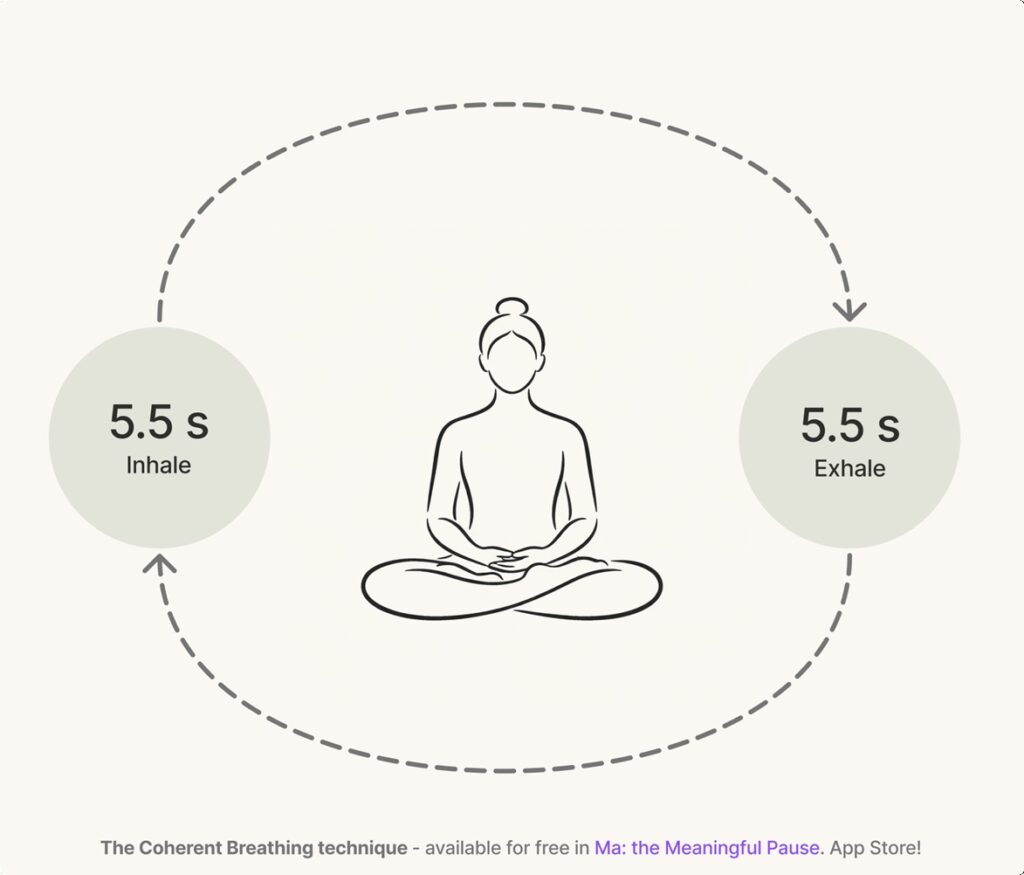
There are no holds. The extended duration is where most of the effect accumulates, so longer sessions (more repetitions) tend to work better than few. That said, even five minutes makes a difference.
If you don’t want to sit and count in your head, you can download my app Ma for free in App Store, and be guided by the rythm of a drum.
What to Expect
The first few minutes can feel slow, especially if you are used to a faster breathing pace. Stick with it. Most people notice a shift somewhere between two to five minutes in. The mind gets more quiet, the body settles and you feel sort of a balance in your body. Some people find it easier to stay in the present by closing their eyes and focus on the sound or sensation of the breath.
Building a Habit
Ten minutes a day is a good starting point. Morning or evening both work well. Unlike more activating techniques, coherent breathing can be done before sleep without interfering with it. The effects build with regular practice, so consistency matters more than session length.
What Happens in the Body
At rest, most people breathe between 12-20 times per minute. Coherent breathing brings that down to around five to six breaths per minute. At this rate, something specific happens: the cardiovascular, respiratory, and nervous systems synchronize.
This synchronization is sometimes called resonance frequency. When breathing slows to around 0.1 hertz, heart rate oscillations align with the breathing cycle in a way that maximizes heart rate variability, HRV.
Higher HRV is associated with better autonomic flexibility, improved stress regulation, and reduced anxiety.
The mechanism runs through the vagus nerve. Slow, diaphragmatic breathing stimulates vagal activity, which shifts the nervous system toward parasympathetic dominance. The equal length of inhale and exhale is important here. Unlike extended exhale techniques that emphasize calming, coherent breathing creates balance rather than strong activation in either direction.
Safety
Coherent breathing is gentle and safe for most people. If you feel light-headed, you are likely breathing too deeply. Reduce the volume of each breath and keep the rhythm. There are no breath holds, so it is suitable for people who need to avoid retention, including during pregnancy or with high blood pressure.
Where It Comes From
The term coherent breathing was developed by Stephen Elliott in the early 2000s, drawing on research into heart rate variability and resonance frequency breathing. The physiological principle behind it, that slow breathing at around six breaths per minute maximizes HRV, had been studied since the 1990s by researchers including Paul Lehrer at Rutgers University.
The practice itself is not new. Pranayama traditions have used slow, equal breathing for centuries. Sama vritti, the yogic equal breath, follows the same structure.
What the Research Shows
A 2014 study found that breathing at 5.5 breaths per minute with equal inhale and exhale produced higher HRV than breathing at 6 breaths per minute, or with unequal inhale and exhale lengths.
A randomized controlled study found that four weeks of daily resonance breathing significantly improved HRV, reduced perceived stress, and improved cognitive performance in young adults.
Worth noting: a large 2023 study found that coherent breathing improved mood and reduced anxiety, but exhale-focused breathing like cyclic sighing showed stronger effects on mood.
Coherent breathing is not the most powerful technique for immediate mood improvement, but it is one of the most consistent for nervous system regulation over time.