
Wim Hof breathing is a controlled hyperventilation technique followed by breath retention. It temporarily alters blood chemistry, produces a distinct physical response, and creates a mental state that many practitioners use as an entry point for meditation or inner work.
Wim Hof breathing was my way into meditation. Or tummo, which is the Tibetan version of pretty much the same thing if you only take the breathing parts into account. I love this breathwork technique because it makes your body very relaxed, and your mind still.
How To
Lie down (or sit). Do not practice standing!
- The breathing phase: Take 30 deep breaths. Inhale fully through the nose or mouth, filling the chest and the belly (diaphragmatic breathing). Exhale without forcing, letting the breath fall out. Keep the pace steady. You will likely feel tingling and light-headedness, but this is normal so don’t be scared.
- The retention: After the last exhale, hold your breath on empty lungs. Hold until the urge to breathe returns naturally, typically 1-3 minutes depending on your experience. With each consecutive round the retention will typically feel longer, but longer retention times are not the point. Stay focused and try not to let your mind wander. Use the stillness to observe what arises.
- The recovery breath: When the urge to breathe returns, inhale fully and hold for 15 seconds. Then exhale. That is one round.
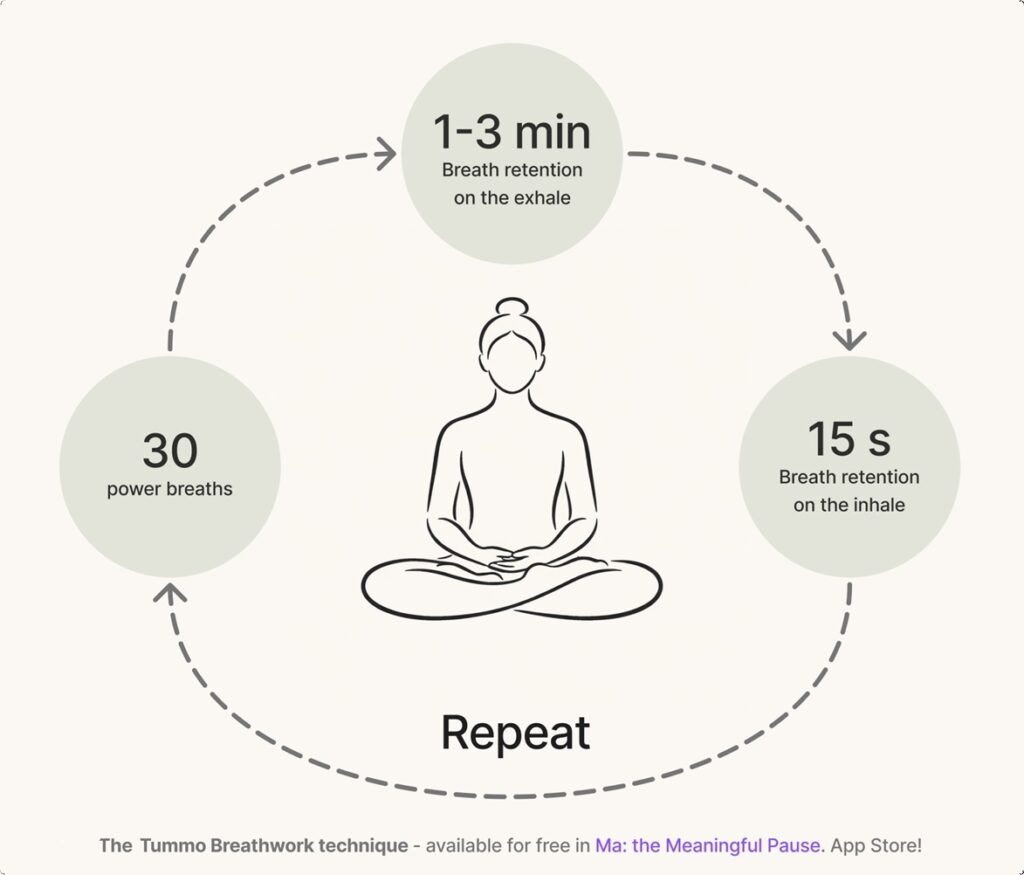
With each round you will feel progressively more relaxed. Three to four rounds is standard, but you can continue for longer.
If you want to practice tummo without tracking timing yourself, Ma guides you through each round with audio cues.
What to Expect
During the power breaths you may experience tingling and light-headedness. This goes away when you breath normally again. Some feel energized after a session, others deeply still. Both are common. The experience varies between people and between sessions.
Safety
Breath retention can cause loss of consciousness in rare cases. Never practice in or near water. Never practice while driving. Always sit or lie down. If you feel faint, stop and breathe normally.
People with cardiovascular conditions, epilepsy, or a history of fainting should consult a doctor before trying this. Also, it’s not recommended during pregnancy.
What Happens in the Body
The 30 rapid deep breaths lower CO2 levels in the blood. As CO2 drops, blood pH rises and becomes more alkaline, a state called respiratory alkalosis. Blood vessels constrict slightly, producing the characteristic tingling in hands, feet, and face. The blood is saturated with oxygen, but because CO2 is what allows hemoglobin to release oxygen to the cells, the cells paradoxically receive less of it during this phase. This is the Bohr effect.
When you stop breathing after the final exhale, CO2 begins rising again. Oxygen saturation drops, sometimes significantly. Adrenaline is released. The combination of these chemical shifts, along with the sudden quiet of the nervous system, produces the state that many practitioners describe during retention: reduced mental chatter, heightened body awareness, and a stillness that can be difficult to access through conventional meditation.
A study of Antarctic expedition members practicing WHM described the retention phases, lasting two to three minutes each, as equivalent to ten minutes of relaxed meditation. Many experienced practitioners use this window deliberately for introspection or as preparation for silent meditation afterward.
Who Is Wim Hof?
Wim Hof is a Dutch athlete, known as The Iceman for his ability to withstand extreme cold. He holds multiple Guinness World Records, including climbing Kilimanjaro in shorts and running a half marathon barefoot above the Arctic Circle. He attributes his abilities to the method he developed, which has three components: breathing, cold exposure, and mental focus. The breathing technique is the foundation and can be practiced independently.
The Connection to Tummo
The breathing pattern shares structural similarities with tummo, the Tibetan Buddhist practice of inner fire. Both involve cyclical deep breathing followed by retention. Wim Hof has acknowledged tummo as a reference point. Tummo integrates visualization and operates within a spiritual framework. WHM works with the same physiological mechanism without religious or visualization components.
What the Research Shows
The most significant study was published in PNAS in 2014 by researchers at Radboud University Medical Center. Twelve WHM-trained practitioners were injected with bacterial endotoxin alongside twelve untrained controls. The trained group produced higher levels of anti-inflammatory interleukin-10, showed lower pro-inflammatory cytokines, and reported fewer flu-like symptoms. It was the first controlled demonstration that humans could voluntarily influence their innate immune response.
A 2025 randomized trial with 404 participants compared WHM against mindfulness meditation over 29 days. WHM showed greater momentary improvements in energy, mental clarity, and ability to handle stress after each session. Meditation showed stronger effects on trait anxiety and sleep quality over time.
A 2024 systematic review of controlled studies found promising evidence for WHM’s effect on inflammatory response, with mixed findings on exercise performance.