
Cultures that had no contact with each other reached the same conclusion: breath is the most direct expression of life force. Control of the breath leads to control of the mind, and breathing practice is preparation for or inseparable from meditation. The names differ. In India it is prana, in China qi, in Tibet lung, in Greece pneuma, in Japan ki. The underlying framework is consistent across traditions that developed independently.
Most people who practice breathwork today are working within a tradition far older than they realize. The techniques have modern names and secular framings, but the physiological principles they rely on were identified, systematized, and refined across multiple civilizations over thousands of years. Each tradition developed detailed practices, preserved them in writing, and transmitted them across generations.
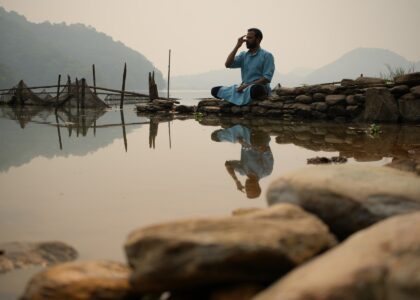
India: Pranayama
The Indian tradition is the most extensively documented. Its central concept, prana, appears in texts dating back to 3000 BCE and refers to the life force that breath most directly expresses. By around 700 BCE this had developed into pranayama, a formal system of breath regulation.
Patanjali later placed it as the fourth step in the eight-limbed yoga system, positioned deliberately between physical practice and meditation. The 15th century Hatha Yoga Pradipika gave it its most technical form, naming and describing the specific techniques still practiced today.
The classical framework distinguished four phases of the breath cycle: puraka (inhalation), kumbhaka (retention after inhalation), rechaka (exhalation), and bahya kumbhaka (retention after exhalation). Kumbhaka, the hold, was considered the most significant phase.
For a deeper look at pranayama’s history and what the research shows, see our full guide to pranayama.
China: Qi and the Breathing Arts
In China, the parallel concept to prana is qi, written 氣, a character that depicts steam rising from rice as it cooks. Qi means breath, air, vapor, and vital energy simultaneously. The oldest direct evidence of systematic breath practice is a jade artifact from between the 6th and 3rd centuries BCE, inscribed with 45 characters describing how to circulate the breath through the body.
The broader tradition is called xingqi, “circulating qi,” and it encompasses qigong, Taoist meditation, daoyin breathing exercises, and the internal arts of martial practice. Qigong in its modern form integrates body movement, breath regulation, and mental focus, but its roots extend back to the Warring States period, 475 to 221 BCE.
The Taoist philosophical framework held that qi permeates everything, and that breath is the primary means by which a person regulates that flow. Laozi’s Dao De Jing and Zhuangzi’s writings both describe meditative cultivation through breath as a path to harmony with the natural order. Chinese medicine incorporated these insights into clinical practice.
Qigong has been recognized as a standard medical technique in China since 1989.
Tibet: Tummo and the Inner Fire
In Tibetan Buddhism, the practice of tummo, which translates as “inner fire,” belongs to the Six Yogas of Naropa, a set of advanced tantric meditation techniques transmitted through the Kagyu lineage. The Tibetan word for wind or breath energy is lung, functioning similarly to prana and qi: a subtle energy that animates the body and can be directed through practice.
Tummo combines specific breathing patterns with detailed visualization of flame at the navel center. Within the tradition, the purpose is spiritual. The observable physical effect, raising core body temperature voluntarily, is considered a byproduct.
In 1981, Harvard cardiologist Herbert Benson traveled to the Himalayas and documented Tibetan monks raising the temperature of their fingers and toes by up to 17 degrees Fahrenheit during tummo practice.
A 2013 study by Kozhevnikov and colleagues confirmed measurable increases in core body temperature in both expert practitioners and Western non-meditators trained in the breathing component alone. The research identified two mechanisms: the breathing technique increases metabolic heat production, while visualization amplifies the effect.
Wim Hof has cited tummo as a reference point for his method. The two share structural similarities in their breathing patterns, but tummo is embedded in a complete spiritual and visualization practice. The Wim Hof method works with the physiological mechanism without the religious or visualization components.
You can try Tummo in my app Ma. It’s free, and the experience is a very deep profound one.
Greece: Pneuma
The Greek tradition produced a philosophical framework rather than a practical system of exercises, but the core observation was the same. Anaximenes, a philosopher from Miletus working around 585 to 525 BCE, wrote that “just as our soul, being air, holds us together, so breath and air encompass the whole world.” Breath was understood as a microcosmic expression of a cosmic principle.
The Greeks called this breath-force pneuma, from the verb pnein, to breathe or blow. Hippocrates and his school placed pneuma at the center of physiology, describing it as circulating through the body and maintaining health. Aristotle formalized the concept further. The Stoics, particularly Zeno of Kition and Chrysippus, extended pneuma into a complete cosmology: a material force, a blend of air and fire, that provided the universe with cohesion and dynamic properties. The human soul was pneuma in its highest concentration.
Greek philosophy did not develop a detailed system of breathing exercises alongside its theory of breath. The observation that breath is the most direct expression of the life force animating all things is present, but it remained primarily theoretical.
Japan: Kokyu
The Japanese word kokyu literally means breath, but carries a broader cosmological meaning. In Japanese Shinto thought, the universe itself breathes, expanding and contracting in a rhythm that individual human breathing reflects. Kokyu is linked to ki, Japan’s equivalent of qi and prana: universal energy generated and regulated through breath.
Breathing practice entered Japan’s martial and meditative traditions through Buddhism and Taoism arriving from China and India. When Zen Buddhism was adopted by the warrior class from the Muromachi period onward, its meditative disciplines including breath training became integrated into swordsmanship and other martial arts. In classical Japanese martial arts, kokyu is never a separate technique. It is inseparable from posture, timing, and intention.
Tanden breathing, directing breath toward the lower abdomen, grounds the body’s center of gravity and is foundational across aikido, kendo, and judo. In 1757, the Zen monk Hakuin Ekaku published Yasen Kanna, describing how he cured himself of “Zen sickness” using a naikan breathing and introspection method. It is considered one of Japan’s first popular health books.
Practice These Techniques in Ma
Ma includes guided sessions for several of the techniques that trace directly to these traditions, including bhramari and coherent breathing from pranayama, and box breathing, which shares its structure with classical kumbhaka practice. Each session can flow directly into meditation.